
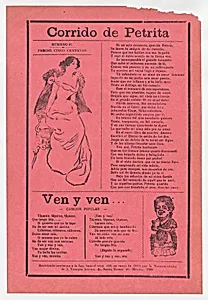
Broadsheet with two different love songs, woman wearing an evening gown sitting on the edge of her seat and another woman holding a cup
ca. 1918 (published)
Medium
Zincograph and letterpress on pink paper
Dimensions
Sheet: 11 13/16 × 7 7/8 in. (30 × 20 cm)
Classification
Prints
Department
Drawings and Prints
Museum
Metropolitan Museum of Art, New York, NY
Credit
The Elisha Whittelsey Collection, The Elisha Whittelsey Fund, 1946
Accession Number
46.46.211
Rights
Public Domain
Tags
Art Historical Context
This vibrant broadsheet, created around 1918 by the legendary Mexican printmaker José Guadalupe Posada in collaboration with publisher Antonio Vanegas Arroyo, captures the playful spirit of early 20th-century popular culture. Titled *Broadsheet with two love songs, woman wearing an evening gown on the edge of her and another woman holding a cup*, it features two stylish women—one poised eagerly in an evening gown, the other casually holding a cup—illustrating romantic lyrics printed alongside. Produced on eye-catching pink paper, the sheet measures about 12 by 8 inches, making it an affordable, handheld treasure from Mexico City's bustling streets. Posada's zincograph technique, a cost-effective form of lithography using zinc plates combined with letterpress for text, allowed for mass production of these corridos (ballads) and songs. Broadsheets like this were vital "people's media" during the Mexican Revolution era (1910–1920), disseminating entertainment, news, and satire to everyday folk, many of whom couldn't read but cherished the imagery and melodies. Posada's bold, satirical style—often blending humor with social commentary—made him a folk hero of Mexican graphic art, influencing later icons like Diego Rivera and modern Day of the Dead imagery. Though focused on lighthearted love themes here, this piece reflects women's evolving roles in urban life, preserved in The Metropolitan Museum of Art's Elisha Whittelsey Collection as a snapshot of revolutionary Mexico's cultural pulse.
About the Artist
José Guadalupe Posada|Antonio Vanegas Arroyo · 1852–1913
José Guadalupe Posada (1852-1913) was a Mexican printmaker and engraver who revolutionized popular art and created some of the most iconic images in Mexican culture. Working primarily with publisher Antonio Vanegas Arroyo, he produced over 20,000 images during his career—inexpensive broadsheets sold for a penny on colored paper that made his art accessible to even the poorest workers. He transform...