
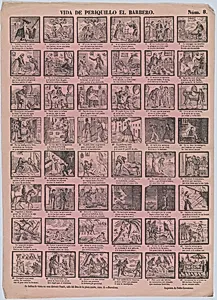
Broadside with 48 scenes from the life of Periquillo the Barber
ca. 1860–70
Medium
Wood engraving printed on pink paper
Dimensions
Sheet: 17 5/16 × 12 3/16 in. (44 × 31 cm)
Classification
Prints
Department
Drawings and Prints
Museum
Metropolitan Museum of Art, New York, NY
Credit
Max G. Wildnauer Fund, 1978
Accession Number
1978.643.33(3)
Rights
Public Domain
Tags
Art Historical Context
This vibrant broadside, created around 1860–70 by Antonio Bosch and Pedro Corominas, captures the lively story of Periquillo the Barber through forty-eight sequential scenes. Printed as a wood engraving on distinctive pink paper, the large sheet measures roughly 17 by 12 inches and was designed for wide public distribution. The medium’s crisp lines and affordability allowed intricate narratives to reach everyday audiences, turning a single sheet into an accessible form of entertainment and moral storytelling. Wood engraving, a technique refined in the nineteenth century, enabled fine detail and mass production, making it ideal for popular prints that blended humor, adventure, and everyday life. The scenes feature men, women, infants, and animals, suggesting a picaresque tale following the barber’s colorful adventures. Such broadsides served as affordable alternatives to books, offering visual literacy to viewers who might not have read written versions. Today, this work in the Metropolitan Museum’s collection highlights how print culture bridged art and popular imagination during Spain’s Romantic era. Its playful format and colorful paper continue to charm viewers, reminding us of the enduring power of sequential storytelling.