
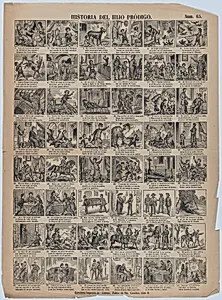
Broadside with 48 scenes relating to the story of the prodigal son
ca. 1860–70
Medium
Wood engraving
Dimensions
sheet: 17 1/8 x 12 5/8 in. (43.5 x 32.1 cm)
Classification
Prints
Department
Drawings and Prints
Museum
Metropolitan Museum of Art, New York, NY
Credit
Max G. Wildnauer Fund, 1978
Accession Number
1978.643.26(2)
Rights
Public Domain
Tags
Art Historical Context
This captivating wood engraving broadside by Juan Llorens, around 1860–70, presents the timeless biblical parable of the Prodigal Son from Luke15 in an extraordinary sequence of 48 intricate scenes. Printed on a single sheet measuring 17⅛ × 12⅝ inches, it unfolds the son's lavish departure, wasteful indulgences, humiliating return, and joyful reconciliation with his father. Everyday figures—men, women, horses, and even birds—populate the vignettes, bringing the moral tale of forgiveness and redemption to life with dynamic energy. As a wood engraving, Llorens's work exemplifies a 19th-century technique prized for its fine detail and affordability, allowing mass production of illustrative prints. Broadside formats like this were popular in Europe, especially in Spain (suggested by the artist's name), for disseminating religious stories to the literate and illiterate alike through visual storytelling. These affordable sheets hung in homes or taverns, serving as both devotional aids and entertaining narratives. Housed in the Metropolitan Museum of Art's Drawings and Prints department (acquired via the Max G. Wildnauer Fund in 1978), this piece highlights how art bridged faith and popular culture in the Victorian era, compressing a profound lesson into a compact, scroll-like panorama that invites viewers to trace the prodigal's journey step by step.