
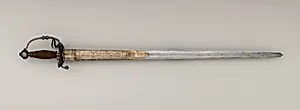
Broadsword
Unknown Artist
dated 1612
Medium
Steel, brass wire, gold
Dimensions
L. 36 5/8 in. (93 cm); L. of blade 30 7/8 in. (78.4 cm); W. 4 3/4 in. (12.1 cm); D. 3 3/4 in. (9.5 cm); Wt. 1 lb. 13 oz. (822.1 g)
Classification
Swords
Culture
German, Solingen
Department
Arms and Armor
Museum
Metropolitan Museum of Art, New York, NY
Credit
Gift of William H. Riggs, 1913
Accession Number
14.25.1143
Rights
Public Domain
Art Historical Context
This finely crafted broadsword, dated 1612 and hailing from Solingen, Germany—the renowned "City of Blades"—emplifies the pinnacle of early 17th-century European manufacturing. Measuring nearly 37 inches long with a 31-inch steel blade, it weighs just under 2 pounds striking a balance of power and maneuverability ideal for infantry combat. Solingen's smiths were for their superior steel production, drawing on centuries-old techniques to forge blades that were both razor-sharp and resilient during an era of escalating conflicts, like the looming Thirty Years' War. The hilt features brass wire wrapping for a secure grip and subtle gold accents, blending functionality with subtle luxury. These materials not only enhanced durability—brass resisting corrosion, gold denoting prestige—but also showcased the meticulous artistry of Solingen workshops, where blades were often etched, blued, or damascened for export across Europe. As a broadsword, it was designed for powerful slashing blows, reflecting the shift from medieval rapiers to heavier, battle-ready weapons. A generous gift to the Metropolitan Museum of Art from William H. Riggs in 1913, this piece invites us to ponder the blacksmith's skill and the soldier's valor, bridging craftsmanship and history in the Arms and Armor collection.