
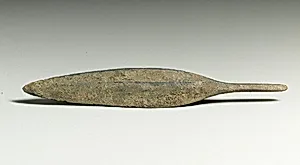
Bronze arrowhead
Unknown Artist
ca. 1450–1050 BCE
Medium
Bronze
Dimensions
length 5 3/8 in. (13.6 cm)
Classification
Bronzes
Culture & Period
Cypriot · Late Bronze Age
Department
Greek and Roman Art
Museum
Metropolitan Museum of Art, New York, NY
Credit
The Cesnola Collection, Purchased by subscription, 1874–76
Accession Number
74.51.5300
Rights
Public Domain
Art Historical Context
This sleek bronze arrowhead, hailing from ancient Cyprus during the Late Bronze Age (. 1450–1050 BCE), offers a glimpse into a vibrant island culture renowned for its mastery of metalworking. Measuring 5 3/8 inches (13.6 cm) in length, its robust, socketed design allowed it to be securely hafted onto a shaft, making it a formidable projectile in warfare or hunting. Cyprus, rich in copper deposits, was a key hub for bronze production and international trade, exporting weapons and goods across the eastern Mediterranean. Crafted through lost-wax casting or similar techniques, this arrowhead exemplifies the technical prowess of Cypriot bronzesmiths, who alloyed copper with tin for superior strength and sharpness. Such artifacts were essential tools in a period of escalating conflicts and migrations, reflecting the martial society of the time. Its simple yet functional form highlights the practical artistry of the era, where beauty emerged from utility. Part of The Cesnola Collection at The Metropolitan Museum of Art—acquired through public subscription in 1874–76—this piece preserves Cyprus's legacy as a Bronze Age powerhouse, bridging the gap between everyday life and epic ancient narratives.