
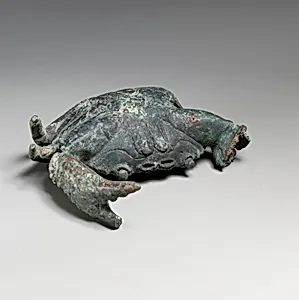
Bronze crab
Unknown Artist
3rd–1st century BCE
Medium
Bronze
Dimensions
2 1/4 × 6 1/2 × 5 1/2 in., 2 lb. (5.7 × 16.5 × 14 cm)
Classification
Bronzes
Culture & Period
Greek · Hellenistic
Department
Greek and Roman Art
Museum
Metropolitan Museum of Art, New York, NY
Credit
Purchase, Mr. and Mrs. John Moscahlaidis Gift, 1992
Accession Number
1992.11.69
Rights
Public Domain
Tags
Art Historical Context
This exquisite **Bronze Crab**, crafted by an unknown artist during the Hellenistic period (3rd–1st century BCE), exemplifies the mastery of naturalistic sculpture. From the vibrant era following Alexander the Great's conquests, Hellenistic art shifted toward hyper-realism and emotional expressiveness, often celebrating the wonders of the natural world. At just over 6 inches long and weighing 2 pounds, thisutive bronze figure captures the crab's intricate anatomy—clawed legs poised in motion, textured shell, and segmented body—with astonishing detail, inviting viewers to marvel at ancient observational skill. Forged in bronze using the sophisticated lost-wax casting technique, common in Greek workshops, the piece highlights the medium's durability and ability to convey subtle textures and sheen. Bronzes like this were prized for their lifelike patina and were often used as votive offerings, decorative weights, or symbols in symposia, reflecting everyday marine life from the Aegean shores. Housed in the Metropolitan Museum of Art's Greek and Roman Art Department (purchased with the gift of Mr. and Mrs. John Moscahlaidis in 1992), this crab evokes the Hellenistic fascination with nature's diversity, bridging art, science, and ritual in a single, timeless form. A delightful reminder of how ancients found beauty in the ordinary!