
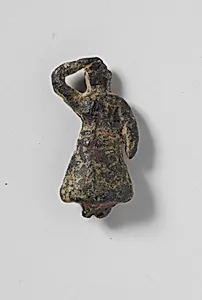
Bronze female figure
Unknown Artist
ca. 1700–1600 BCE
Medium
Bronze
Dimensions
H.: 1 7/16 in. (3.7 cm)
Classification
Bronzes
Culture & Period
Minoan · Middle Minoan III
Department
Greek and Roman Art
Museum
Metropolitan Museum of Art, New York, NY
Credit
Funds from various donors, 1924
Accession Number
24.150.9
Rights
Public Domain
Tags
Art Historical Context
This delicate bronze female figure, standing just 1 7/16 inches (3.7 cm) tall, hails from the vibrant Minoan civilization on Crete during the Middle Minoan III period (ca. 1700–1600 BCE). Crafted by an unknown artist, it exemplifies the early mastery of bronze casting in the Aegean Bronze Age, a medium prized for its durability and luster. Minoan bronzes like this one are exceedingly rare, as ancient peoples often melted them down for reuse, making survivors precious windows into a lost world. Likely a votive offering for a sanctuary, the figurine reflects the Minoans' reverence for female deities or priestesses, a recurring theme in their art symbolizing fertility, nature, and divine power. The lost-wax technique used here allowed for intricate details, capturing graceful forms that foreshadow later Greek sculpture. Discovered and acquired by the Metropolitan Museum of Art in 1924 through donor funds, it invites us to ponder the rituals of a palace-centered society famed for frescoes, bull-leaping, and thalassocracy—maritime dominance. Today, in the Greek and Roman Art department, this tiny treasure connects visitors to Minoan ingenuity, reminding us how everyday devotion shaped enduring cultural legacies.