
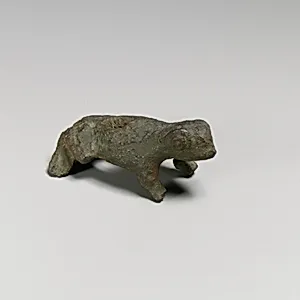
Bronze frog
Unknown Artist
ca. 575–550 BCE
Medium
Bronze
Dimensions
H.: 1 in. (2.5 cm) Other: 2 3/8 in. (6 cm)
Classification
Miscellaneous-Iron
Culture & Period
Etruscan · Archaic
Department
Greek and Roman Art
Museum
Metropolitan Museum of Art, New York, NY
Credit
Rogers Fund, 1903
Accession Number
03.23.54
Rights
Public Domain
Tags
Art Historical Context
This delightful bronze frog, crafted by unknown Etruscan artist around 575–550 BCE, the whimsical spirit of Archaic-period artistry. Measuring just 1 inch (2. cm) high and 2⅜ inches (6 cm) long, this tiny figurine exemplifies the Etruscans' mastery of-scale bronze casting, likely using the lost-wax to achieve its smooth, lifelike form. Housed in the Metropolitan Museum of Art's Greek Roman Art Department (acquired via the Rogers Fund in 1903), it reflects the vibrant metallurgical traditions of ancient Italy's Etruscan civilization, which flourished before Roman dominance. Etruscans, renowned for their bronze workshops, produced such objects as votive offerings, amulets, or decorative attachments—perhaps for furniture or jewelry. Frogs held symbolic resonance in ancient Mediterranean cultures, often linked to fertility, water, and renewal due to their life cycle, though this piece's exact function remains a tantalizing mystery. Its compact size and naturalistic pose highlight the period's shift toward more dynamic, observant representations, bridging Orientalizing influences and emerging realism. Step closer in the gallery to admire how this unassuming frog embodies Etruscan ingenuity, inviting us to ponder the everyday wonders that enchanted the ancient world.