
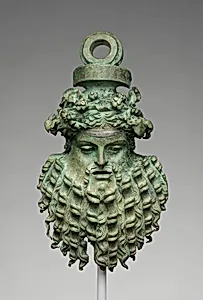
Bronze handle attachment in the form of a mask
Unknown Artist
1st century BCE–1st century CE
Medium
Bronze
Dimensions
H. 10 in. (25.4 cm)
Classification
Bronzes
Culture & Period
Greek or Roman · Late Hellenistic or Early Imperial
Department
Greek and Roman Art
Museum
Metropolitan Museum of Art, New York, NY
Credit
Bequest of Walter C. Baker, 1971
Accession Number
1972.118.98
Rights
Public Domain
Tags
Art Historical Context
This striking bronze handle attachment, crafted in the form of a mask during the 1st century BCE to 1st century CE, exemplifies the seamless blend of utility and artistry in ancient Greek and Roman material culture. Likely once adorning a vessel, chest, or piece of furniture, the object transforms a practical component into a expressive face, capturing the viewer's attention with its sculptural presence. Standing 10 inches tall, the piece reflects the technical mastery of bronze casting, a medium prized in the ancient Mediterranean for its durability, sheen, and capacity to render fine details. Dating to the Late Hellenistic or Early Imperial period, this work bridges Greek artistic traditions with emerging Roman tastes. Masks held deep cultural resonance in both societies, evoking themes from theater, ritual, and mythology. As an everyday object elevated by figurative design, it highlights how ancient artisans infused functional items with symbolic depth, inviting contemplation of identity and emotion even in utilitarian contexts. Housed in the Metropolitan Museum’s Department of Greek and Roman Art, this artifact—acquired through the bequest of Walter C. Baker—offers visitors a tangible connection to the creative ingenuity of the ancient world. Its classification among bronzes underscores the enduring appeal of such works, which combined technical precision with evocative imagery to enrich daily life.