
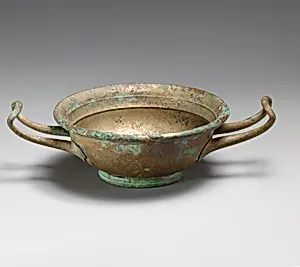
Bronze kylix (drinking cup)
Unknown Artist
4th–3rd century BCE
Medium
Bronze
Dimensions
H.: 1 7/8 in. (4.8 cm)
Classification
Bronzes
Culture & Period
Greek · Late Classical or Hellenistic
Department
Greek and Roman Art
Museum
Metropolitan Museum of Art, New York, NY
Credit
Rogers Fund, 1921
Accession Number
21.88.67
Rights
Public Domain
Art Historical Context
This delicate bronze kylix, a shallow drinking cup with two horizontal handles, hails from ancient Greece during the Late Classical or Hellenistic period (4th–3rd BCE). Standing just 1 7/8 inches (4.8 cm) tall, its petite size belies its cultural importance as a vessel for symposia—lively social gatherings where elite men reclined, drank wine, and engaged in philosophical discourse, poetry, and games. Crafted by an unknown artisan, it exemplifies the refined metalwork of the era, when bronze was prized for its durability, luster, and prestige over more common ceramics. Bronze kylikes like this one were often used for mixing and sipping diluted wine, a staple of Greek hospitality and ritual. The metal's cool weight in the hand would have enhanced the sensory experience, while its patina today hints at centuries of burial and rediscovery. Techniques likely involved casting or hammering, showcasing Greek mastery in alloying copper and tin for a balanced strength and sheen. Now housed in the Metropolitan Museum of Art's Greek and Roman Art Department (acquired via the Rogers Fund in 1921), this kylix offers a tangible window into everyday luxury and the vibrant social fabric of classical antiquity, reminding us how even small objects carried profound communal meaning.