
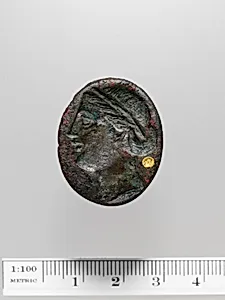
Bronze ring
Unknown Artist
ca. 3rd century BCE
Medium
Bronze, gold
Dimensions
Length: 1 1/8 in. (2.9 cm)
Classification
Gems
Culture & Period
Greek · Hellenistic
Department
Greek and Roman Art
Museum
Metropolitan Museum of Art, New York, NY
Credit
Bequest of W. Gedney Beatty, 1941
Accession Number
41.160.480
Rights
Public Domain
Tags
Art Historical Context
This delicate bronze ring, dating to around the 3rd century, exemplifies the exquisite craftsmanship of Hellenistic Greek jewelry Measuring just 1 1/8 inches (2.9 cm) in, it belongs to the class of ancient gems—small, engraved objects often used as seals, amulets, or personal adornments. Crafted from bronze with accents of gold, its bezel likely features an intimate portrait of a woman's head, a motif common in Hellenistic art that reflects the period's shift toward more naturalistic and individualized representations. The Hellenistic era (ca. 323–31 BCE), following Alexander the Great's conquests, saw a flourishing of portable luxury arts across the expanded Greek world. Such rings were worn by both men and women of status, serving practical purposes like signing documents while doubling as symbols of identity or devotion—perhaps evoking a goddess like Athena or a revered figure. The use of bronze, a durable alloy, combined with precious gold, highlights innovative metalworking techniques, including fine chasing or inlay, that allowed for intricate details on such a tiny scale. Today, this gem resides in the Metropolitan Museum of Art's Greek and Roman Art Department, thanks to the 1941 bequest of W. Gedney Beatty. It invites us to ponder the daily lives and aesthetic sensibilities of ancient Greeks, where even the smallest object carried profound cultural weight.