
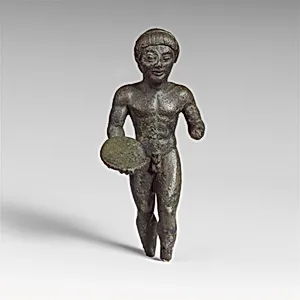
Bronze statuette of a discus thrower
Unknown Artist
5th century BCE
Medium
Bronze
Dimensions
H.: 3 3/8 in. (8.6 cm)
Classification
Bronzes
Culture & Period
Etruscan · Classical
Department
Greek and Roman Art
Museum
Metropolitan Museum of Art, New York, NY
Credit
Fletcher Fund, 1925
Accession Number
25.78.34
Rights
Public Domain
Tags
Art Historical Context
This exquisite bronze statuette of a discus thrower crafted by an unknown Etruscan artist in the5th century BCE, the poised tension of an athlete mid-motion. Standing just 3 3/8 inches (8.6 cm) tall, the nude male figure embodies the Classical ideal of the human body—muscular, balanced, and dynamically contrapposto—as he winds up to hurl the discus. Acquired through the Fletcher Fund in 1925, it now graces the Greek and Roman Art department at the Metropolitan Museum of Art. Etruscan bronzes like this one highlight the culture's mastery of lost-wax casting, a technique that allowed for intricate details and lifelike anatomy, often lost when originals were melted down in antiquity. Produced during the Classical period, it reflects Etruscans' admiration for Greek athletic prowess and competitive sports, integral to festivals and religious rites. Such small-scale works were likely votive offerings or personal talismans, blending Italic innovation with Hellenic influence. Though modest in size, this statuette offers a window into Etruscan vitality and their pivotal role as cultural bridges between Greece and Rome, celebrating the male nude as a symbol of strength and harmony.