
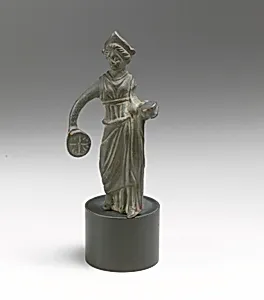
Bronze statuette of a goddess
Unknown Artist
ca. 3rd–1st century BCE
Medium
Bronze
Dimensions
H. 3 3/8 in. (8.6 cm)
Classification
Bronzes
Culture & Period
Italic · Hellenistic
Department
Greek and Roman Art
Museum
Metropolitan Museum of Art, New York, NY
Credit
Purchase, 1896
Accession Number
96.9.416
Rights
Public Domain
Tags
Art Historical Context
This exquisite bronze statuette of a goddess, standing just 3 3/8 inches (8.6 cm) tall, dates to the Hellenistic period (ca. 3rd–1st century BCE) and hails from Italic culture in ancient Italy. Crafted by an unknown artist, it exemplifies the refined bronzework of pre Italic peoples, who were influenced by the dynamic Hellenistic styles spreading from Greece after Alexander the Great's conquests. Such small-scale figures were likely votive offerings dedicated at sanctuaries or cherished as household deities (lares), embodying divine protection and piety in everyday life. Bronze was a prized medium for its durability and ability to capture intricate details through the lost-wax casting technique, allowing artisans to create fluid drapery, expressive poses, and subtle facial features that convey the goddess's serene authority. Though her exact identity remains a mystery—possibly a local Italic deity akin to Greek counterparts like Artemis or Demeter—this statuette highlights the cultural fusion in the Mediterranean world, where Italic workshops blended indigenous traditions with Hellenistic realism and grace. Acquired by the Metropolitan Museum of Art in 1896, this rare survivor from antiquity offers a window into the spiritual and artistic vitality of Hellenistic Italy, reminding us how portable bronzes bridged the divine and the domestic in ancient societies.