
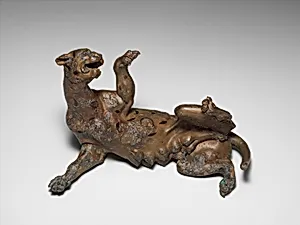
Bronze statuette of a pantheress
Unknown Artist
1st–2nd century CE
Medium
Bronze, copper, silver, niello
Dimensions
Other: 5 1/2 x 4 1/4 x 8 5/8 in. (14 x 10.8 x 21.9 cm)
Classification
Bronzes
Culture & Period
Roman · Imperial
Department
Greek and Roman Art
Museum
Metropolitan Museum of Art, New York, NY
Credit
Rogers Fund, 1907
Accession Number
07.261
Rights
Public Domain
Tags
Art Historical Context
This exquisite bronze statuette of a pantheress, crafted in the Roman Imperial period (1st–2nd century CE), captures the wild grace of one of antiquity's most evocative animals. Standing just over 8 inches long, the figurine gleams with intricate details: its sleek form rendered in bronze, accented by copper, silver inlays, and niello—a sophisticated black sulfide technique used to create striking contrasts in metalwork. Such multi-metal embellishments highlight the technical prowess of Roman artisans, who reserved these methods for high-status objects. In the bustling world of Imperial Rome, panthers symbolized untamed power and were often linked to the god Bacchus (Dionysus), evoking themes of revelry and mystery. Small-scale bronzes like this one adorned elite homes, gardens, or shrines, serving both decorative and possibly ritual purposes. Its survival from over 1,900 years ago speaks to the durability of bronze and the reverence for naturalistic animal forms in Greco-Roman art. Acquired through the Rogers Fund in 1907, this piece now graces the Metropolitan Museum of Art's Greek and Roman Art department. Visitors can't help but admire how it brings the ferocity and elegance of the ancient wild to life— a testament to Rome's mastery of form and fantasy.