
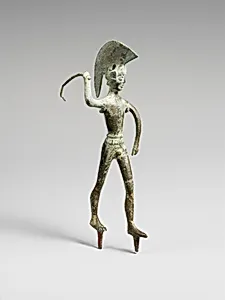
Bronze statuette of a warrior
Unknown Artist
5th century BCE
Medium
Bronze
Dimensions
H.: 6 11/16 in. (17 cm)
Classification
Bronzes
Culture & Period
Etruscan · Classical
Department
Greek and Roman Art
Museum
Metropolitan Museum of Art, New York, NY
Credit
Purchase, 1896
Accession Number
96.9.433
Rights
Public Domain
Tags
Art Historical Context
This exquisite bronze statuette of a warrior, standing just 6 11/16 inches (17 cm) tall, hails from Etruscan culture in the5th century BCE during Classical period. Crafted by an unknown artist, it captures the poised figure of a helmeted male warrior, embodying the martial prowess revered in ancient Etruria—an Italic civilization that flourished in central Italy before Roman dominance. Acquired by the Metropolitan Museum of Art through purchase in 1896 it now resides in the Greek and Roman Art department, a testament to Etruscan mastery in bronze casting. Etruscans were renowned bronzeworkers, often employing the lost-wax technique to create intricate, hollow figures like this one, which allowed for fine details in musculature, drapery, and armor. The warrior's helmet and stance evoke influences from Greek hoplite imagery, reflecting Etruria's cultural exchanges with the Hellenic world via trade and colonization. Such statuettes likely served votive purposes in sanctuaries or as grave offerings, symbolizing protection and heroism. For visitors, this piece offers a window into Etruscan society’s blend of ferocity and artistry, highlighting how small-scale bronzes preserved the grandeur of larger lost monuments. A subtle yet powerful survivor from antiquity!