
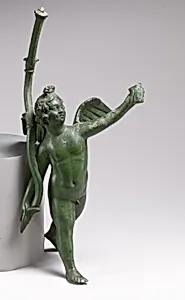
Bronze statuette of Eros running
Unknown Artist
1st–2nd century CE
Medium
Bronze
Dimensions
H.: 9 1/2 in. (24.1 cm)
Classification
Bronzes
Culture & Period
Roman · Early Imperial
Department
Greek and Roman Art
Museum
Metropolitan Museum of Art, New York, NY
Credit
Gift of Henry G. Marquand, 1897
Accession Number
97.22.5
Rights
Public Domain
Tags
Art Historical Context
This elegant bronze statuette portrays Eros, the Greek god of love, captured mid-run in a lively pose that conveys youthful energy and swift movement. Created in the 1st–2nd century CE during Rome’s Early Imperial period, the small figure—measuring just 9½ inches high—exemplifies the Roman fascination Greek mythology. Roman artists adapted Greek deities like Eros (known as Cupid in Latin traditions), blending them into everyday artistic expression across the empire. Bronze was a favored medium for such works because its durability and capacity for fine detail allowed sculptors to achieve dynamic compositions through lost-wax casting. These portable statuettes often adorned Roman homes, gardens, or shrines, serving decorative and votive functions while celebrating themes of desire and vitality central to imperial culture. Acquired by the Metropolitan Museum through a gift from Henry G. Marquand in 1897, the piece offers modern viewers an intimate connection to the artistic tastes of ancient Rome, where mythological figures animated both public and private spaces.