
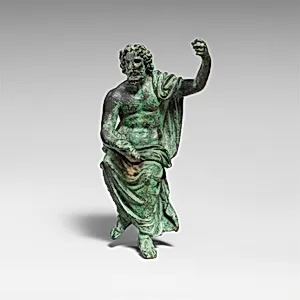
Bronze statuette of Jupiter Capitolinus
Unknown Artist
1st–2nd century CE
Medium
Bronze
Dimensions
H. 3 13/16 in. (9.7 cm)
Classification
Bronzes
Culture & Period
Roman · Imperial
Department
Greek and Roman Art
Museum
Metropolitan Museum of Art, New York, NY
Credit
Rogers Fund, 1917
Accession Number
17.230.32
Rights
Public Domain
Tags
About this artwork
This bronzes titled "Bronze statuette of Jupiter Capitolinus" dates to 1st–2nd century CE. Executed in bronze, this work represents Roman, Imperial artistic traditions. The piece demonstrates the technical skill and artistic vision characteristic of its period. The work's presence in a major museum collection attests to its significance in the broader narrative of art history. As part of institutional holdings, it serves both scholarly research and public education, offering insights into the cu...
Art Historical Context
This exquisite bronze statuette of Jupiterolinus, dating to the 1st–2nd century CE, the Roman Empire's reverence for its supreme deity. Standing just 3 13/16 inches (9.7 cm) tall, the figure portrays Jupiter, king of the gods and protector of the Eternal City, likely in his majestic Capitoline form—adorned with attributes like a thunderbolt or scepter, evoking power and divine authority. Crafted during the Imperial period, it reflects Rome's blend of Greek influences with distinctly Roman grandeur, where small-scale bronzes like this adorned household shrines, public temples, or served as votive offerings. Bronze was a prized medium in Roman art, valued for its durability and ability to convey lifelike details through lost-wax casting techniques. Artisans skillfully rendered the god's muscular form, flowing drapery, and authoritative pose, showcasing the technical mastery of the era. As a symbol of imperial might and religious devotion, Jupiter Capitolinus embodied the state's divine sanction, central to rituals on Rome's Capitoline Hill. Today, housed in the Metropolitan Museum of Art's Greek and Roman Art Department (acquired via the Rogers Fund in 1917), this statuette offers a tangible glimpse into daily Roman spirituality and artistry. It reminds visitors how portable piety connected the divine to everyday life in an empire-spanning culture.