
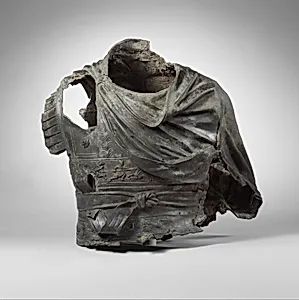
Bronze torso from an equestrian statue wearing a cuirass
Unknown Artist
2nd century BCE–2nd century CE
Medium
bronze
Dimensions
H. 25 in. (63.5 cm) Width: 26 1/2 in (67.3 cm) Depth: 15 in (38.1 cm)
Classification
Bronzes
Culture & Period
Greek or Roman · Hellenistic or Imperial
Department
Greek and Roman Art
Museum
Metropolitan Museum of Art, New York, NY
Credit
Bequest of Bill Blass, 2002
Accession Number
2003.407.7
Rights
Public Domain
Tags
Art Historical Context
This striking bronze torso, hailing from the Hellenistic or early Imperial period (2nd century BCE–2 century CE), once formed part of an equestrian depicting a commanding figure clad in a cuirass—a sculpted breastplate mimicking idealized musculature. Measuring about 25 inches tall, this fragment captures the upper body of a rider, evoking the grandeur of ancient Greek or Roman sculptures that adorned public spaces, temples, and victory monuments. Its muscular anatomy and detailed armor reflect the classical pursuit of heroic perfection, blending realism with divine proportions. Bronze was the premium medium for such works, cast using advanced lost-wax techniques that allowed for intricate detailing, though few survive today due to melting for reuse. Equestrian statues like this celebrated military leaders or gods, symbolizing power, conquest, and equestrian prowess in a world where horsemanship defined warriors. The cuirass, often worn by figures like Alexander the Great or Roman emperors, underscores themes of protection and valor, bridging Hellenistic dynamism with Roman imperial propaganda. On view in the Metropolitan Museum of Art's Greek and Roman Art department, this torso—generously bequeathed by Bill Blass in 2002—offers a tantalizing glimpse into antiquity's lost splendor, inviting us to imagine the full statue thundering across a marble forum.