
Brooch
ca. 1900
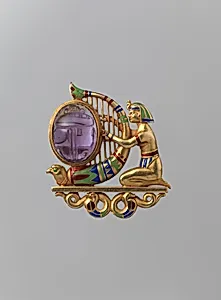
Medium
Gold, amethyst, demantoid garnet, and enamel
Dimensions
1 1/4 × 1 1/8 in. (3.2 × 2.9 cm)
Classification
Brooch
Culture
American
Department
The American Wing
Museum
Metropolitan Museum of Art, New York, NY
Credit
Gift of Jacqueline Loewe Fowler, 2013
Accession Number
2013.605
Rights
Public Domain
Tags
Art Historical Context
This exquisite brooch, crafted by Theodore B. Starr around 1900, exemplifies the pinnacle of American jewelry design during the Gilded Age., a renowned New York City jeweler, drew inspiration from ancient motifs, blending delicate human figures, harps, and Egyptian scarabs into a harmonious composition. Measuring just 1¼ × 1⅛ inches, this petite wearable artwork transforms personal adornment into a miniature narrative, evoking mythology and music in a style reminiscent of Renaissance revival and emerging Art Nouveau influences. The brooch's materials—gold, amethyst, demantoid, and enamel—highlight masterful techniques of the era. Demantoid garnets, prized for their brilliant fire rivaling diamonds, add vivid green accents, while translucent enamel provides luminous depth and color, likely executed in the champlevé method for intricate detailing. Amethysts lend regal purple hues, underscoring the piece's opulence. Housed in The Metropolitan Museum of Art's American Wing as a gift from Jacqueline Loewe Fowler in 2013, this brooch reflects America's fascination with Egyptomania at the turn of the century, fueled by archaeological discoveries. It captures the cultural sophistication of elite society, where jewelry served as both status symbol and artistic statement.