
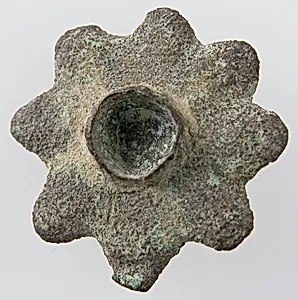
Brooch
Unknown Artist
8th–9th century
Medium
Copper alloy, champlevé enamel
Dimensions
Overall: 13/16 x 1/4 in. (2 x 0.6 cm)
Classification
Metalwork-Copper alloy
Culture
Merovingian
Department
Medieval Art
Museum
Metropolitan Museum of Art, New York, NY
Credit
Gift of Bastiaan Blok, 1991
Accession Number
1991.260.2
Rights
Public Domain
Art Historical Context
This exquisite Merovingian brooch dating to the 8th–9th century, exemplifies the refined metalworking skills of early medieval Europe. Crafted from copper alloy and adorned with champlevé enamel sophisticated technique where troughs are carved into the metal, filled with powdered glass enamel, and fired to create vibrant, durable colors—this tiny jewelry piece (just 13/16 x 1/4 inches) as a practical fastener for clothing while doubling as a status symbol. Merovingian culture, named after the Frankish dynasty that ruled much of Gaul from the 5th to 8th centuries, blended Germanic traditions with Roman influences. Enamelwork like this was prized for its luminous effects, often featuring geometric or animal motifs that symbolized protection or prestige. Though the artist's identity is lost to time, the brooch's precision highlights the era's artisanal workshops, bridging the late Merovingian period into the Carolingian Renaissance. A generous gift to the Metropolitan Museum of Art from Bastiaan Blok in 1991, this artifact invites us to imagine a wearer fastening their cloak with such a sparkling treasure, whispering tales of daily life in a transformative age.