
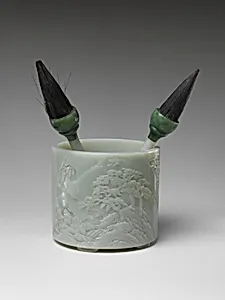
清中期 玉管筆(二支)|Brush holder with two brushes
Unknown Artist
18th century
Medium
Jade (nephrite)
Dimensions
Brush holder: H. 6 in. (15.3 cm); Diam. 6 3/4 in. (17.2 cm) Brush (each): L. 12 1/8 in. (30.8 cm)
Classification
Jade
Culture & Period
China · Qing dynasty (1644–1911)
Department
Asian Art
Museum
Metropolitan Museum of Art, New York, NY
Credit
Gift of Heber R. Bishop, 1902
Accession Number
02.18.623a–c
Rights
Public Domain
Tags
Art Historical Context
This exquisite jade brush holder, accompanied by two matching brushes, hails from mid-Qing dynasty China in the 18th century a golden age for imperial craftsmanship. Carved from nephrite jade—a tough, luminous stone revered for its purity and translucency—the piece stands 6 inches tall with a 6¾-inch diameter, while each brush measures over 12 inches long. Subtle tree motifs, likely adorning the holder, evoke the natural world, a common theme in Chinese art symbolizing longevity and harmony. Jade carving reached extraordinary heights during the Qing era (1644–1911), with artisans employing intricate techniques like incising and relief work to transform raw stone into functional scholar's tools. Nephrite's durability allowed for fine details, making such objects prized possessions for the literati elite, who used them in calligraphy studios as symbols of refinement and cultural attainment. Today, this rare set graces the Metropolitan Museum of Art's Asian Art collection, a gift from Heber R. Bishop in 1902. It offers a window into Qing opulence, blending utility with artistry in a material that has captivated Chinese culture for millennia.