
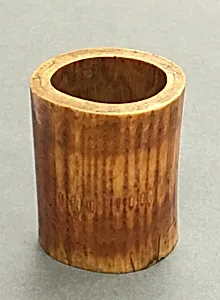
Brush pot
Unknown Artist
late 19th–20th century
Medium
Ivory
Dimensions
H. 3 in. (7.6 cm); Diam. (max.) 2 1/4 in. (5.7 cm)
Classification
Ivories
Culture
China
Department
Asian Art
Museum
Metropolitan Museum of Art, New York, NY
Credit
Gift of Shou-cheng Zhang and Xiu-ping Loh Zhang, 2000
Accession Number
2000.514.49
Rights
Public Domain
Art Historical Context
This delicate ivory brush pot, crafted in China during the late 19 to early 20th, exemplifies the refined artistry of the scholar's studio. Measuring just 3 inches tall with a maximum diameter of ¼ inches, it served a practical yet elegant purpose: holding calligraphy brushes upright in water to keep their tips supple. Such objects were staples among China's educated elite, blending functionality with aesthetic beauty in the tradition of wenfangsi, or "scholar's four treasures" (brush, ink, paper, and inkstone). Carved from ivory—a luxurious material prized for its creamy translucency and ability to capture intricate details— this piece highlights masterful techniques honed over centuries. Artisans skillfully shaped the dense elephant tusk, often revealing its natural grain through precise incisions and polishing to create smooth, tactile surfaces. Ivory carvings like this reached new heights of sophistication in the late Qing dynasty and Republican era, reflecting cultural reverence for craftsmanship amid shifting political landscapes. Today, this brush pot graces the Metropolitan Museum of Art's Asian Art collection, a generous gift from Shou-cheng Zhang and Xiu-ping Loh Zhang in 2000. It invites us to appreciate the harmony of form and utility in Chinese decorative arts, a testament to an era's enduring elegance.