
Buckle
Unknown Artist
450–500
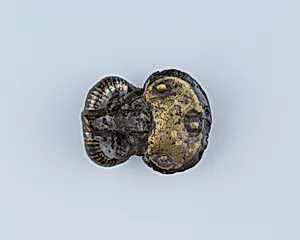
Medium
Iron, copper alloy
Dimensions
H. 1 1/2 in. (3.9 cm); W. 1 7/8 in. (4.7 cm); thickness 13/16 in. (2 cm); Wt. 1.2 oz. (34 g)
Classification
Miscellaneous-Buckles & Ornament
Culture
Frankish
Department
Arms and Armor
Museum
Metropolitan Museum of Art, New York, NY
Credit
Gift of J. Pierpont Morgan, 1917
Accession Number
17.193.49
Rights
Public Domain
Art Historical Context
This exquisite Frankish buckle, dating to around 450–500 CE, offers a glimpse into the daily life and craftsmanship of the early medieval Franks, a Germanic people who rose to prominence in what is now France and Germany after the fall of the Roman Empire.ed from sturdy iron for durability—ideal for securing belts on clothing, armor, or horse gear—and accented with copper alloy for decorative flair, it measures a compact 1 ½ by 1 ⅞ inches. Such small yet functional objects were essential for warriors and elites, blending utility with subtle ornamentation during the turbulent Migration Period. The buckle's design reflects advanced metalworking techniques of the era, likely involving forging, riveting, and possibly inlay work to highlight the copper alloy against the iron. As part of the Metropolitan Museum of Art's Arms and Armor collection—generously gifted by J. Pierpont Morgan in 1917—it exemplifies Frankish material culture under early Merovingian rulers. These buckles weren't mere fasteners; they signaled status and tribal identity amid the shift from Roman provincial life to barbarian kingdoms. Today, this unassuming artifact reminds us how everyday items preserve history, showcasing the Franks' ingenuity in an age of transformation. Visit it at the Met to appreciate its tactile weight—just 1.2 ounces—and imagine it cinching a chieftain's belt.