
Buckle
Unknown Artist
middle of 6th century
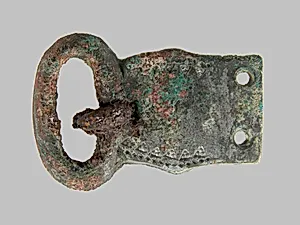
Medium
Copper alloy, silvered
Dimensions
Overall: 1 3/16 x 13/16 x 1/4 in. (3 x 2 x 0.6 cm)
Classification
Metalwork-Copper alloy
Culture
Frankish
Department
Medieval Art
Museum
Metropolitan Museum of Art, New York, NY
Credit
Gift of J. Pierpont Morgan, 1917
Accession Number
17.193.233
Rights
Public Domain
Art Historical Context
This exquisite Frankish buckle, crafted in the mid-6th century, offers a glimpse into the daily life and artistry of the early Merovingian period. Belonging to the Frankish culture—a Germanic people who dominated much of western Europe after the fall of Rome—this small metalwork piece (just 1 3/16 x 13/16 x 1/4 inches) likely adorned a belt or strap, serving both practical and decorative purposes. Its presence in the Metropolitan Museum of Art's Medieval Art Department, gifted by J. Pierpont Morgan in 1917, highlights its value as a rare survivor from an era of transition between antiquity and the Middle Ages. Made of copper alloy with silvering, the buckle showcases sophisticated metalworking techniques. The silver overlay—a process where a thin silver layer was applied to the base metal—created a luxurious sheen, mimicking more precious materials like silver or gold. This affordable yet elegant method was common in Frankish craftsmanship, allowing wider access to ornate personal accessories that signified status and identity. As a testament to Frankish innovation, this buckle reflects the blend of Roman influences and emerging Germanic styles in early medieval Europe. Though its unknown artist remains anonymous, the object's precision and subtle embellishments underscore the high level of skill in everyday metalwork, inviting us to appreciate the artistry hidden in the functional objects of the past.