
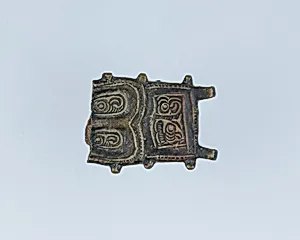
Buckle Shank
Unknown Artist
5th–7th century
Medium
Bronze
Dimensions
L. 3 1/2 in. (8.9 cm); W. 1 3/8 in. (3.5 cm); thickness 3/8 in. (1 cm); Wt. 1.5 oz. (42 g)
Classification
Miscellaneous-Buckles & Ornament
Culture
Visigothic
Department
Arms and Armor
Museum
Metropolitan Museum of Art, New York, NY
Credit
Rogers Fund, 1920
Accession Number
20.153.18a, b
Rights
Public Domain
Art Historical Context
This exquisite bronze buckle shank, crafted by an unknown Visigothic artisan the 5th and 7th centuries, offers a glimpse into the daily life and craftsmanship of early medieval Europe. Measuring just 3½ inches long and weighing a mere 1.5 ounces, this sturdy yet elegantly proportioned piece—housed in the Metropolitan Museum of Art's and Armor Department—was likely part of a larger belt buckle or harness ornament. Acquired through the Rogers Fund in 0, it exemplifies the practical beauty of Visigothic metalwork. The Visigoths, a Germanic people who established a kingdom across Iberia and southern Gaul after the fall of the Roman Empire, were renowned for their skill in bronze casting and decoration. This shank, with its precise dimensions and robust thickness, highlights techniques like lost-wax casting or hammering, which allowed for both functionality and subtle ornamentation. Such buckles adorned belts, straps, and military gear, serving as status symbols that blended utilitarian design with cultural pride. In the turbulent post-Roman world, objects like this shank bridged Roman traditions and emerging medieval aesthetics, underscoring the Visigoths' role in shaping European history. Visitors will appreciate how this small artifact reveals the artistry behind everyday essentials of a warrior elite.