
Buckle Tongue
Unknown Artist
3rd–5th century
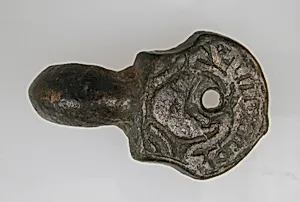
Medium
Copper alloy
Dimensions
Overall: 1 9/16 x 15/16 x 7/16 in. (3.9 x 2.4 x 1.1 cm)
Classification
Metalwork-Copper alloy
Culture
Late Roman
Department
Medieval Art
Museum
Metropolitan Museum of Art, New York, NY
Credit
Gift of J. Pierpont Morgan, 1917
Accession Number
17.191.193
Rights
Public Domain
Art Historical Context
This delicate "Buckle Tongue," crafted from copper alloy during the Late Roman period (3rd–5th century), offers a glimpse into the everyday ingenuity of the waning Roman Empire. Measuring just 1 9/16 x 15/16 x 7/16 inches, this small component—likely the pivoting pin of a belt buckle—was essential for securing clothing, military gear, or horse harnesses. As part of the Metropolitan Museum of Art's Medieval collection (gift of J. Pierpont, 1917), it bridges the classical world and early medieval Europe, highlighting the continuity of Roman metalworking traditions. Copper alloy, a durable and corrosion-resistant mix often including zinc or tin, was prized for its affordability and workability compared to precious metals like gold or silver. Artisans likely cast or hammered this piece, achieving a functional form with subtle precision that speaks to skilled craftsmanship amid the empire's turbulent transitions—barbarian invasions, economic shifts, and cultural fusions. Such buckles were ubiquitous, adorning tunics and belts across social classes, from soldiers on the frontier to civilians in bustling towns. Though unadorned, its survival underscores the cultural importance of practical metalwork in Late Roman life, where even humble objects reflected technological prowess and daily resilience. Visitors, picture this tiny tongue securing a legionary's belt during a march along Hadrian's Wall— a testament to Rome's enduring legacy.