
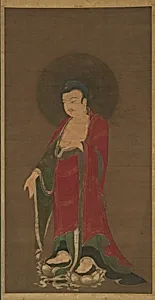
南宋 佚名 阿彌陀佛圖 軸|Buddha Amitabha Descending from His Pure Land
Unknown Artist
late 13th century
Medium
Hanging scroll; ink, color, and gold on silk
Dimensions
Image: 41 1/8 x 21 1/8 in. (104.5 x 53.7 cm) Overall with mounting: 71 1/2 x 28 1/4 in. (181.6 x 71.8 cm) Overall with knobs: 71 1/2 x 30 3/8 in. (181.6 x 77.2 cm)
Classification
Paintings
Culture & Period
China · Southern Song dynasty (1127–1279)
Department
Asian Art
Museum
Metropolitan Museum of Art, New York, NY
Credit
Rogers Fund, 1987
Accession Number
1987.148
Rights
Public Domain
Tags
Art Historical Context
This exquisite hanging scroll, titled *Buddha Amitabhaending from His Pure Land dates to the late 13th century during the Southern Song dynasty (112–1279). Created an unknown artist, it masterfully depicts Amitabha Buddha, the central figure of Pure Land Buddhism, descending from his Western Paradise to guide devotees toward enlightenment. Rendered in ink, color, and gold silk, the painting measures 41 1/8 x 21 1/8 inches, with an elaborate mounting that emphasizes its role as a ceremonial object for meditation and worship. Southern Song art flourished amid political upheaval after the Jurchen invasion, fostering a refined academy style prized for its elegance and spiritual depth. Hanging scrolls like this were unrolled for private contemplation, often in scholarly or monastic settings, allowing viewers to immerse themselves in the Buddha's radiant aura. The use of gold highlights evokes the otherworldly splendor of Amitabha's Pure Land, a realm of lotus blooms and celestial attendants symbolizing salvation through faith and recitation of his name—a core tenet of Chinese Pure Land Buddhism. Now in the Metropolitan Museum of Art's Asian Art collection (Rogers Fund, 1987), this work exemplifies the dynasty's fusion of technical virtuosity and devotional fervor, inviting visitors to ponder the promise of rebirth in paradise.