
仏手柑図|Buddha’s Hand Citron (Busshukan)
mid-19th century
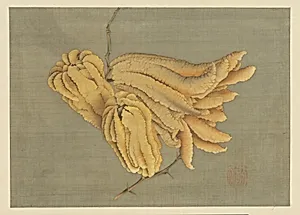
Medium
Matted painting; ink and color on silk
Dimensions
13 1/2 x 9 5/8 in. (34.3 x 24.4 cm)
Classification
Paintings
Culture & Period
Japan · Edo period (1615–1868)
Department
Asian Art
Museum
Metropolitan Museum of Art, New York, NY
Credit
H. O. Havemeyer Collection, Bequest of Mrs. H. O. Havemeyer, 1929
Accession Number
29.100.536
Rights
Public Domain
Art Historical Context
Katsushika Hokus, the legendary Japanese artist renowned for his ukiyo-e woodblock prints like *The Great Wave off Kanag*, created this intimate *Buddha’s Hand Cit (Busshukan)* in the mid-19th century during Japan’s Edo period (1615–8). This small matted painting (13½ × 9⅝ in.) captures the distinctive, finger-like form of the busshukan, a citron variety prized for its exotic shape and fragrant peel. Hokusai’s masterful depiction highlights the fruit’s textured skin and luminous quality, showcasing his lifelong fascination with nature’s intricate details. Rendered in ink and color on silk—a traditional medium for Japanese paintings—this work exemplifies Hokusai’s versatility beyond prints. The delicate silk surface allows for subtle gradations of color and fluid brushwork, emphasizing the fruit’s organic curves and subtle shading. Such album-leaf or hanging scroll formats were popular among Edo-period collectors, blending artistry with portability. Culturally, the Buddha’s hand citron symbolizes Buddhist prayer hands, prosperity, and longevity, often offered at temples during festivals. Part of the Metropolitan Museum of Art’s H. O. Havemeyer Collection (1929), this piece reflects Hokusai’s enduring influence on global art, bridging Japan’s vibrant Edo aesthetic with timeless natural symbolism.
About the Artist
Katsushika Hokusai · 1760–1849
Katsushika Hokusai (1760-1849) stands as one of history's most influential artists, a Japanese master who revolutionized the ukiyo-e woodblock print tradition and profoundly shaped Western art. Born in the Katsushika district of Edo (modern-day Tokyo) to an artisan family, Hokusai lived through nearly nine decades of extraordinary creative evolution, adopting over thirty different artistic names t...