
遼 鎏金青銅大日如來像|Buddha Vairocana (Dari)
Unknown Artist
11th century
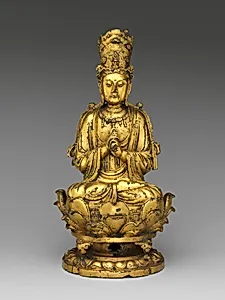
Medium
Gilt bronze; lost-wax cast
Dimensions
H. 8 5/8 in. (21.9 cm); W. 4 3/8 in. (11.1 cm); D. 4 1/4 in. (10.8 cm); Diam. of base 3 3/4 in. (9.5 cm)
Classification
Sculpture
Culture & Period
China · Liao dynasty (907–1125)
Department
Asian Art
Museum
Metropolitan Museum of Art, New York, NY
Credit
Purchase, Lila Acheson Wallace Gift, 2006
Accession Number
2006.284
Rights
Public Domain
Tags
Art Historical Context
This exquisite gilt bronze statue of Buddha Vairocana crafted in 11th-century China during the Liao dynasty (–1125), stands just 8⅝ inches tall, embodying the cosmic Buddha at the center of the universe in esoteric Buddhism. Vairocana, known as the "Great Sun Buddha," radiates enlightenment, often depicted with serene features and symbolic lotuses signifying purity rising from worldly mud. Produced by an unknown artist, this sculpture reflects the Liao Khitan rulers' fervent patronage of Buddhism, blending Central Asian influences with refined Chinese artistry. The lost-wax casting technique allowed for its intricate details—from the flowing robes and gentle hand gestures (mudras) invoking wisdom to the lotus pedestal—while gilding with gold lent a luminous glow evoking divine light. Liao bronzes like this are prized for their realistic proportions and dynamic poses, rarer than Tang or Song counterparts due to the dynasty's turbulent history. Acquired by the Metropolitan Museum of Art in 2006, it offers a window into a golden era of Buddhist devotion on the steppes.