
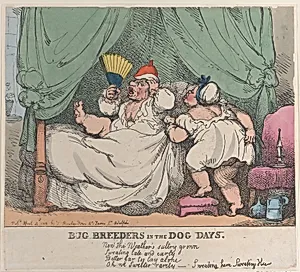
Bug Breeders in the Dog Days
April 4, 1812
Medium
Hand-colored etching
Dimensions
Sheet: 10 in. × 11 1/8 in. (25.4 × 28.2 cm)
Classification
Prints
Department
Drawings and Prints
Museum
Metropolitan Museum of Art, New York, NY
Credit
The Elisha Whittelsey Collection, The Elisha Whittelsey Fund, 1959
Accession Number
59.533.1484
Rights
Public Domain
Tags
Art Historical Context
Thomas Rowlandson’s “Bug Breeders in the Dog Days,” a hand-colored etching from April 1812, offers a lively glimpse into early nineteenth-century British social satire. Rowlandson, renowned for his witty caricatures of Georgian life, frequently used the etching medium to reach wide audiences through affordable, vividly tinted prints. The work’s modest scale—just over ten by eleven inches—made it ideal for domestic display or personal collections. Set in a bedroom during the sweltering “dog days” of summer, the print pokes gentle fun at human discomfort and perhaps the literal pests that plagued households. Its tags—bedrooms, men, women, and caricature—hint at Rowlandson’s characteristic blend of humor and mild innuendo, typical of his era’s print culture. Created the same year Napoleon’s forces were retreating from Moscow, the sheet reflects a moment when Londoners sought light relief from war news and seasonal irritations. Acquired by the Metropolitan Museum through the Elisha Whittelsey Fund, this impression preserves the bright watercolor washes that brought Rowlandson’s scenes to life for contemporary viewers. Today it invites us to appreciate both the technical charm of hand-colored etching and the enduring appeal of art that finds comedy in everyday annoyances.
About the Artist
Thomas Rowlandson · 1756–1827
Thomas Rowlandson (1757–1827) was an English artist and caricaturist whose satirical watercolors and prints captured the social life of Georgian Britain with unparalleled wit and technical mastery. Alongside James Gillray, he is recognized as one of the greatest British graphic artists, and his distinctive flowing line and keen observations have made his work integral to understanding late 18th an...