
舞楽図屏風 ・唐獅子図屏風|Bugaku Dances (front); Chinese Lions (reverse)
early 18th century
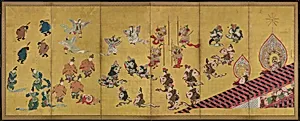
Medium
Pair of six-panel screens; ink, color, and gold leaf on paper
Dimensions
Image: 65 1/8 in. × 14 ft. 2 5/8 in. (165.4 × 433.4 cm) Overall: 72 3/16 in. × 14 ft. 7 3/8 in. (183.3 × 445.4 cm)
Classification
Paintings
Culture & Period
Japan · Edo period (1615–1868)
Department
Asian Art
Museum
Metropolitan Museum of Art, New York, NY
Credit
The Harry G. C. Packard Collection of Asian Art, Gift of Harry G. C. Packard, and Purchase, Fletcher, Rogers, Harris Brisbane Dick, and Louis V. Bell Funds, Joseph Pulitzer Bequest, and The Annenberg Fund Inc. Gift, 1975
Accession Number
1975.268.57, .58
Tags
Art Historical Context
This stunning pair of six-panel folding screens by Hanabusa Itchō, created in the early 18 century during Japan's Edo period (1615–1868), exemplifies the opulent artistry of the time. Crafted with ink, vibrant colors, and shimmering gold leaf on paper, screens measure over 14 feet wide when open, designed as *byōbu* to adorn elite interiors. Itchō, a versatile ukiyo-e artist known his witty, realistic style, captures movement and elegance on the front with scenes of *bugaku*—ancient court dances imported from China and Korea centuries earlier, performed at imperial ceremonies. The reverse sid...
About the Artist
Hanabusa Itchō · 1652–1724
Japanese, 1652–1724