
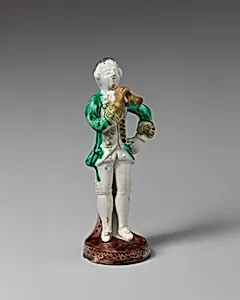
Bugler in military dress
ca. 1750
Medium
Lead-glazed earthenware
Dimensions
Height: 6 1/2 in. (16.5 cm)
Classification
Ceramics-Pottery
Culture
British, Staffordshire
Department
European Sculpture and Decorative Arts
Museum
Metropolitan Museum of Art, New York, NY
Credit
Gift of R. Thornton Wilson, in memory of Florence Ellsworth Wilson, 1943
Accession Number
43.100.11
Rights
Public Domain
Tags
Art Historical Context
This charming lead-glazed earthenware figure titled *Bugler in Military Dress*, was produced around 1750 by the Astbury-Whield partnership in Staffordshire, England—a hub of innovative pottery making during the 18th. Standing just 6½ inches tall, it exemplifies the small-scale ceramic sculptures that became wildly popular as affordable decorative objects for middle-class homes. These "Staffordshire figures" captured everyday heroes, from musicians to soldiers, reflecting Britain's growing fascination with military prowess and public spectacles amid the era's geopolitical tensions, like the Seven Years' War. Crafted from molded earthenware and coated in a glossy lead glaze, the piece showcases the technical brilliance of Staffordshire potters. The lead glaze provided a vibrant, jewel-like sheen that enhanced colors and protected the delicate form, allowing mass production while retaining hand-painted details like the bugler's uniform and instrument. As a musician in crisp military attire, it highlights themes of valor and melody, blending cultural pride with the decorative arts' rise. Today, this rarity graces the Metropolitan Museum of Art's European Sculpture and Decorative Arts collection, gifted in 1943 in memory of Florence Ellsworth Wilson. It offers a delightful glimpse into 18th-century domestic life and the artistry that made Staffordshire synonymous with accessible elegance.