
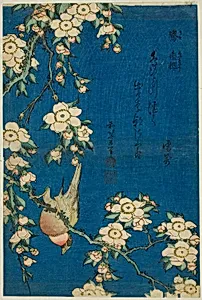
Bullfinch and Weeping Cherry (Uso, shidarezakura), from an untitled series of flowers and birds
c. 1834
Medium
Color woodblock print; chuban
Dimensions
25.5 × 17.1 cm (10 1/16 × 6 3/4 in.)
Classification
woodblock print
Department
Arts of Asia
Museum
Art Institute of Chicago
Accession Number
33224
Rights
Public Domain
Art Historical Context
Nestled among Katsushika Hokusai's vast oeuvre, *Bullfinch and We Cherry (Uso, shidarezakura)* from an untitled series of flowers birds captures the delicate beauty of nature around 1834. This color woodblock print, in the compact chuban format (25.5 × 17.1 cm), exemplifies Hai's mastery of ukiyo-e, the "pictures of the floating world" that celebrated everyday poetry amid Japan's Edo period (1603–1868). Hokusai (1760–1849), renowned for iconic works like *The Great Wave off Kanagawa*, turned his keen eye to kachō-e—bird-and-flower prints that evoked seasonal harmony and the fleeting essence of life. Here, the plump bullfinch perches gracefully on drooping cherry branches, their pink blossoms symbolizing spring's transience in Japanese culture, a theme rooted in wabi-sabi aesthetics. The woodblock technique shines through vibrant layers of color achieved by carving separate blocks for each hue, allowing mass production for an eager public. Housed in the Art Institute of Chicago's Arts of Asia department, this print invites us to savor Hokusai's precise lines and harmonious composition, bridging art and nature in a timeless whisper of impermanence.
About the Artist
Katsushika Hokusai · 1760–1849
Katsushika Hokusai (1760-1849) stands as one of history's most influential artists, a Japanese master who revolutionized the ukiyo-e woodblock print tradition and profoundly shaped Western art. Born in the Katsushika district of Edo (modern-day Tokyo) to an artisan family, Hokusai lived through nearly nine decades of extraordinary creative evolution, adopting over thirty different artistic names t...