
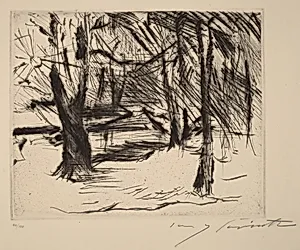
Bäume mit Sonne (Trees in the Sun)
1920-1921
Medium
drypoint in black
Dimensions
plate: 24.5 × 29.8 cm (9 5/8 × 11 3/4 in.) sheet: 38.2 × 62.5 cm (15 1/16 × 24 5/8 in.)
Classification
Department
CG-W
Museum
National Gallery of Art, Washington, D.C.
Credit
Gift of Ruth Cole Kainen
Accession Number
2012.92.58
Rights
Public Domain
Art Historical Context
**Bäume mit Sonne (Trees in the Sun)** Lovis Corinth (1858–1925), a pivotal figure in German Expressionism and a founder of the Berlin Secession, crafted this evocative drypoint etching in 1920–1921, near the end of his prolific career. By this time, Corinth's style had evolved dramatically following a debilitating stroke in 1911, embracing bolder, more spontaneous lines that infused his landscapes with raw emotional intensity. *Bäume mit Sonne* captures sun-dappled trees in a luminous, impressionistic haze, reflecting his lifelong fascination with nature's fleeting light and his shift from meticulous academic training to expressive freedom. Drypoint, Corinth's chosen medium here—a direct etching into a copper plate with a sharp tool—produces the velvety black lines and rich tonal depths that distinguish intaglio prints. The burr raised by the needle creates soft, blurred edges, mimicking the play of sunlight through foliage (plate: 24.5 × 29.8 cm). This technique allowed Corinth to achieve painterly effects on paper, bridging his oil paintings and graphic works during Germany's turbulent Weimar era. Generously gifted to the National Gallery of Art by Ruth Cole Kainen and housed in the Prints department (CG-W), this piece invites visitors to ponder Corinth's resilience and mastery. Its intimate scale on a generous sheet (38.2 × 62.5 cm) draws the eye into a serene yet vibrant natural world, a testament to art's power to illuminate even in twilight years.
About the Artist
Lovis Corinth · 1858–1925
Lovis Corinth, born Franz Heinrich Louis on July 21, 1858, in Tapiau, East Prussia (now Gvardeysk, Russia), to a tanner father, displayed prodigious drawing talent from childhood. He began formal training at the Königsberg Academy in 1876, then moved to the Academy of Fine Arts in Munich from 1880 to 1884, studying under Ludwig von Löfftz and briefly Franz von Defregger, where he absorbed a Realis...