
Bunch of Grapes
1628
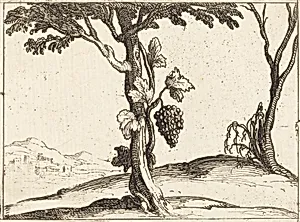
Medium
etching on laid paper
Dimensions
plate: 6.2 × 8.2 cm (2 7/16 × 3 1/4 in.) sheet: 8.1 × 9.9 cm (3 3/16 × 3 7/8 in.)
Classification
Department
CG-E
Museum
National Gallery of Art, Washington, D.C.
Credit
R.L. Baumfeld Collection
Accession Number
1969.15.587
Rights
Public Domain
Art Historical Context
Jacques Callot's *Bunch of Grapes* (1628) is a delightful gem of Baroque printmaking, capturing the lush texture of fruit in an etching on laid paper. Measuring a mere 6.2 × 8.2 cm on the, this intimate work from the National Gallery of Art's R.L. Baumfeld Collection invites close inspection, revealing the artist's extraordinary skill in miniaturization. Callot (1592–1635), a French master etcher from Lorraine, honed his craft in Florence under Medici patronage before returning to his homeland. Renowned for intricate series like *The Miseries of War*, he excelled in etching—a technique using acid to bite fine lines into a metal plate—producing tonal depth and lifelike detail on modest laid paper, which bears the subtle chain lines typical of 17th-century European papermaking. Here, the grapes' plump forms and glistening surfaces showcase his virtuoso linework, blending realism with elegant simplicity. This print holds artistic significance as an early example of still-life etching, reflecting the era's fascination with nature's bounty amid the opulence of courtly life. A testament to printmaking's democratic potential, it allowed such refined imagery to reach collectors far beyond canvas paintings, enriching cultural appreciation of everyday wonders.
About the Artist
Jacques Callot · 1592–1635
Jacques Callot (1592–1635) was a French printmaker and draftsman from the Duchy of Lorraine, widely regarded as one of the first great artists to practice the graphic arts exclusively. His more than 1,400 etchings chronicled the breadth of 17th-century life, from Medici court festivities to the brutal realities of warfare. Callot revolutionized etching through technical innovations including the é...