
Bunting
ca. 1760
Medium
Soft-paste porcelain
Dimensions
2 1/2 × 2 1/4 in. (6.4 × 5.7 cm)
Classification
Ceramics-Porcelain
Culture
British, Bow, London
Department
European Sculpture and Decorative Arts
Museum
Metropolitan Museum of Art, New York, NY
Credit
Gift of Irwin Untermyer, 1964
Accession Number
64.101.720
Rights
Public Domain
Tags
Art Historical Context
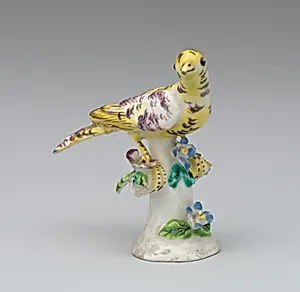
Created around 1760 at London’s Bow Porcelain Factory, this diminutive soft-paste porcelain bunting exemplifies the lively bird figures that helped popularize English porcelain among middle-class collectors. Standing just over two inches tall, the small sculpture captures the compact form and alert posture of a bunting, its feathers delicately modeled and painted in soft naturalistic tones. Bow was among the first English factories to produce porcelain commercially, relying on a soft-paste recipe that fused clay, sand, and glass rather than the true kaolin-based hard paste used in China and later at Meissen. This material allowed for fluid modeling and a warm, slightly translucent surface well suited to small-scale decorative objects. In the mid-eighteenth century, such bird figures reflected growing public interest in natural history and the fashion for arranging porcelain creatures on dining tables or mantelpieces. Though modest in size, the bunting embodies the factory’s contribution to making refined ceramic sculpture newly accessible in Britain.
About the Artist
Bow Porcelain Factory · 1747–1776
The Bow Porcelain Factory, established around 1747 in East London near Bow and relocated by 1749 to "New Canton" east of the River Lea, emerged as one of England's pioneering soft-paste porcelain manufacturers, rivaling the Chelsea factory. Founded by merchant Edward Heylyn and Irish painter Thomas Frye, who secured key patents in 1744 and 1748–49 for using Cherokee kaolin and bone ash, the factor...