
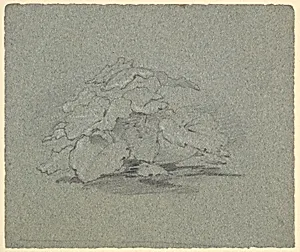
Burdock
1820–90
Medium
Black and white chalk on blue-gray paper
Dimensions
Sheet: 4 1/2 × 5 1/4 in. (11.4 × 13.4 cm)
Classification
Drawings
Department
Drawings and Prints
Museum
Metropolitan Museum of Art, New York, NY
Credit
Purchase, Brooke Russell Astor Bequest, 2013
Accession Number
2013.92
Rights
Public Domain
Tags
Art Historical Context
**Burdock** by George Richmond (1809–1896) is a captivating small-scale drawing that invites close contemplation, measuring just 4½ × 5¼ inches. Created during Richmond's lifetime in the early-to-mid 19th century it depicts the humble burdock plant—a prickly, resilient weed common in British countryside—with a sensitivity that elevates the everyday. As a member of the visionary "Ancients" influenced by William Blake, Richmond infused his works with a mystical appreciation for nature's intricate details, bridging Romanticism and emerging Pre-Raphaelite precision. Executed in black and white chalk on blue-gray paper, the medium allows for dramatic contrasts and subtle tonal modeling. The tinted ground serves as mid-tone, enabling Richmond to sculpt light and shadow efficiently—a technique favored by draftsmen for quick, expressive studies. This method highlights the plant's textured leaves and burrs, creating depth in a compact format ideal for sketchbooks or private reflection. Tagged as an abstraction, *Burdock* distills natural form into essential lines and volumes, foreshadowing modernist simplification while rooted in 19th-century naturalism. Acquired by The Metropolitan Museum of Art in 2013 through the Brooke Russell Astor Bequest, it exemplifies Richmond's enduring legacy in drawings and prints, offering visitors a window into Victorian-era reverence for the wild.
About the Artist
George Richmond · 1809–1896
British, Brompton 1809–1896 London