
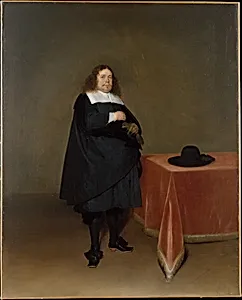
Burgomaster Jan van Duren (1613–1687)
ca. 1666–67
Medium
Oil on canvas
Dimensions
32 1/16 x 25 13/16 in. (81.5 x 65.5 cm)
Classification
Paintings
Department
Robert Lehman Collection
Museum
Metropolitan Museum of Art, New York, NY
Credit
Robert Lehman Collection, 1975
Accession Number
1975.1.141
Rights
Public Domain
Tags
About this artwork
This distinguished portrait exemplifies Gerard ter Borch the Younger's mastery of Dutch Golden Age portraiture at its finest. Painted circa 1666–67, the work depicts Jan van Duren (1613–1687), a burgomaster of Deventer and member of that city's ruling elite. Ter Borch, recognized as one of the seventeenth century's most compelling Dutch artists, was celebrated for his handsome portraits and refined genre subjects that captured the sophistication of prosperous Dutch society. The painting forms ha...
Art Historical Context
Gerard ter Borch the, a leading figure of the Dutch Golden Age, captured the essence of 17th-century prosperity in elegant portrait of Burgomaster van Duren (1613–1687), around 1666–67. Van Duren, a prominent in Deventer, stands as a symbol of the era's mercantile elite, dressed in lavish attire that reflects his status. This oil-on-canvas work, measuring about 32 by 26 inches, forms one half of a splendid pendant pair with his wife Margaretha van Haexbergen's portrait, highlighting the refined domestic partnerships of Dutch patricians. Ter Borch's genius shines in his meticulous rendering of textures—from the rich velvet chair and table to the intricate folds of van Duren's garments—achieved through precise, sensitive brushwork and subtle color harmonies. By stripping away extraneous details, he directs all focus to the sitter's dignified presence, blending material splendor with psychological depth. This approach exemplifies the sophistication of Dutch portraiture, ennobling patrons while conveying their inner character. Acquired in 1975 as part of the Robert Lehman Collection at The Metropolitan Museum of Art, this masterpiece ranks among ter Borch's finest in America, offering visitors a window into the poised world of Golden Age society.