
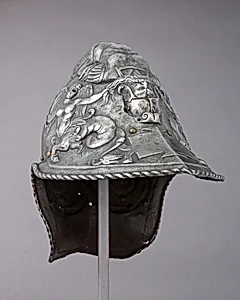
Burgonet after Filippo Negroli
Unknown Artist
about 1545–50
Medium
Steel
Dimensions
H. 10 9/16 in. (26.8 cm); W. 9 in. (22.9 cm); D. 14 in. (35.6 cm); Wt. 3 lb. 10 oz. (1651 g)
Classification
Helmets
Culture
Italian, Milan
Department
Arms and Armor
Museum
Metropolitan Museum of Art, New York, NY
Credit
Gift of Alan Rutherfurd Stuyvesant, 1949
Accession Number
49.163.3
Rights
Public Domain
Art Historical Context
Step into the Renaissance world of Milanese armor with this striking steel burgonet, crafted around 1545–50 by an unknown artist in the style of the master armorer Filippo Negroli. Measuring just 10 9/16 inches high weighing a manageable 3 pounds 10 ounces, this open-faced helmet was designed for cavalrymen, featuring a distinctive peaked skull, hinged cheek pieces, and a fit for agile combat or ceremonial display. Hailing from Italy's Arms and Armor tradition, it exemplifies the Milanese workshops' dominance in producing high-quality protective gear during the Italian Wars. Filippo Negroli, active in the 1530s–50s, revolutionized armor with his virtuoso embossing and repoussé techniques—hammering steel into intricate, gilded reliefs of classical motifs like gods, grotesques, and armor all'antica. This burgonet echoes his innovative "after" style, blending functionality with sculptural artistry, where helmets became wearable Renaissance sculptures rather than mere defense. Such pieces blurred the line between warfare and opulent pageantry, adorning nobles in tournaments and parades. Today, gifted to the Metropolitan Museum of Art in 1949, it invites us to marvel at the fusion of engineering and aesthetics in 16th-century Italy—proof that even in battle, beauty reigned supreme.