
Burying the Dead
Unknown Artist
1618
Medium
Stained glass
Dimensions
Overall: 35 1/2 × 17 in. (90.2 × 43.2 cm)
Classification
Glass-Stained
Culture
Dutch
Department
European Sculpture and Decorative Arts
Museum
Metropolitan Museum of Art, New York, NY
Credit
Gift of Stanley Mortimer, 1951
Accession Number
51.185.3
Rights
Public Domain
Tags
Art Historical Context
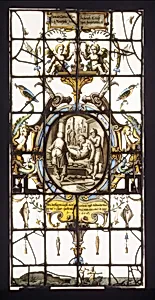
In the quiet glow of stained glass, *Burying the Dead (1618) captures a poignant moment of ritual and mortality from the Dutch Golden Age. This narrow panel, measuring 35½ × 17 inches, men engaged in burial rites, surrounded by symbolic putti—playful cherubic figures often linked to the afterlife—and enigmatic fish, evoking themes of death, resurrection, and perhaps Christian salvation. Crafted by an unknown Dutch artist, it reflects the enduring tradition of glassmaking in the Netherlands, even as Protestant reforms curtailed religious imagery in churches. Stained glass, classified here as a decorative art, involves cutting colored pot-metal glass, painting details with vitreous enamels, and firing before assembling with lead strips. This technique, perfected in medieval Europe, allowed light to animate scenes with jewel-like vibrancy, making *Burying the Dead* a luminous meditation on human transience. Donated to the Metropolitan Museum of Art in 1951 by Stanley Mortimer, the panel highlights secular or vanitas motifs popular in early 17th-century Dutch culture, where everyday rituals intertwined with spiritual reflection amid prosperity and plague. Today, it invites visitors to ponder life's impermanence, its vivid hues transforming a somber subject into a beacon of artistic ingenuity.