
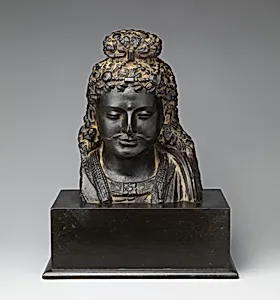
Bust of a Bodhisattva, possibly Maitreya
Unknown Artist
2nd–3rd century
Medium
Schist
Dimensions
H. 9 3/8 in. (23.8 cm); W. 7 1/16 in. (18 cm); D. 4 3/4 in. (12 cm) H. (with base) 13 in. (33 cm)
Classification
Sculpture
Culture
Pakistan, Khyber-Pakhtunkhwa province
Department
Asian Art
Museum
Metropolitan Museum of Art, New York, NY
Credit
Purchase, Mrs. Kim Lam Beleson and her husband Mr. Richard Beleson Gift, in memory of her parents, Mr. Trứ Công Lâm and Mrs. Diệu thị Hồ, 2015
Accession Number
2015.392
Rights
Public Domain
Tags
Art Historical Context
This exquisite bust of a Bodhisatt, possibly Maitreya hails from the ancient Gandhara region in present-day Pakistan's Khyber-Pakhtunkhwa province, in the 2nd–3rd CE from schist, a fine-grained metamorphic stone prized for its durability and to capture intricate details. Standing just over 13 inches tall with its base, this sculpture the anonymous artistry of Gandharan workshops, where skilled stone carvers produced devotional images for Buddhist worship. Gandhara art is renowned for its unique Greco-Buddhist fusion, blending Hellenistic realism—seen in lifelike facial features and flowing drapery—with Indian spiritual iconography. Introduced after Alexander the Great's campaigns and flourishing under Kushan rule, this style helped popularize the human-like depiction of Buddhist figures across Asia. Schist sculptures like this one were often gilded or painted, enhancing their serene, ethereal presence in monasteries and shrines. As a Bodhisattva, the figure embodies compassion and enlightenment; if Maitreya, it represents the Buddha of the future, a key deity in Mahayana Buddhism promising renewal. Acquired by The Metropolitan Museum of Art in 2015 through a generous gift, this piece invites visitors to ponder the cultural crossroads of ancient trade routes, where East met West in stone.