
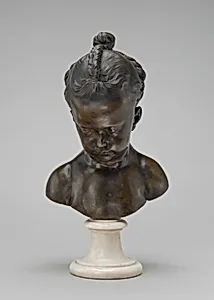
Bust of a Little Girl
model 1744, cast probably 1750/1753
Medium
bronze
Dimensions
overall: 37 x 25.2 x 19.7 cm (14 9/16 x 9 15/16 x 7 3/4 in.)
Classification
Sculpture
Department
CSD
Museum
National Gallery of Art, Washington, D.C.
Credit
Widener Collection
Accession Number
1942.9.128
Rights
Public Domain
Art Historical Context
Jacques-François-Joseph Saly a prominent French sculptor of the Rococo era, crafted this charming *Bust of a Little* around 1744, with the bronze cast likely produced between 1750 and1753. Standing at 37 cm tall, this intimate portrait exemplifies the delicate portraiture favored in mid-18th-century France where sculptors captured the innocence and vitality of youth for private collections among the elite. Saly's work reflects the Rococo style's emphasis on graceful curves, soft textures, and playful naturalism, evoking a sense of tender affection. The bronze medium was ideal for such busts, allowing for fine details in the girl's flowing hair, expressive face, and lightly draped clothing through lost-wax casting techniques. This process—modeling in clay or wax, then casting in metal—preserved the sculptor's nuanced touch, making the piece both durable and lifelike. Saly, trained in Paris and later influential in Denmark, excelled in these child portraits, blending emotional warmth with technical precision. Now part of the Widener Collection at the National Gallery of Art, this bust offers a window into Enlightenment-era fascination with childhood innocence, reminding visitors of art's power to immortalize fleeting moments of joy.
About the Artist
Jacques-François-Joseph Saly (French) · 1717 –1776
French, Valenciennes 1717–1776 Paris