
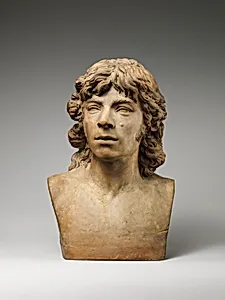
Bust of a man
ca. 1790–95
Medium
Terracotta
Dimensions
Overall (confirmed): 17 1/4 × 11 1/2 × 9 1/2 in. (43.8 × 29.2 × 24.1 cm)
Classification
Sculpture
Culture
French, Lyon
Department
European Sculpture and Decorative Arts
Museum
Metropolitan Museum of Art, New York, NY
Credit
Rogers Fund, 1919
Accession Number
19.29
Rights
Public Domain
Tags
Art Historical Context
This striking terracotta bust of a, crafted by French sculptor Joseph Chinard around 1790–95, captures the intensity of late 18th-century portraiture from Lyon. Measuring 17¼ × 11½ × 9½ inches, it exemplifies Chinard's skill in modeling the human form with neoclassical—sharp features, textured hair, and a direct gaze that convey both dignity and realism. Terracotta, a fired clay medium prized for its warm, earthy tones and malleability, was ideal for sculptors like Chinard to create lively preliminary models or affordable finished works, bridging classical antiquity with revolutionary fervor. Chinard, a native of Lyon—a hotbed of French Revolutionary activity—rose to prominence during this turbulent era. Active from the 1780s onward, he blended neoclassical ideals of proportion and anatomy with the era's demand for individualized, emotive portraits, often honoring revolutionaries or local figures. This bust, likely depicting a contemporary sitter, reflects the period's shift from aristocratic pomp to more democratic expressions of character. Housed in the Metropolitan Museum of Art's European Sculpture and Decorative Arts department (acquired via the Rogers Fund in 1919), it invites visitors to ponder the human stories behind France's transformative years. Chinard's technique—incised details and subtle modeling—highlights terracotta's versatility, making this piece a window into neoclassicism's revolutionary soul.