
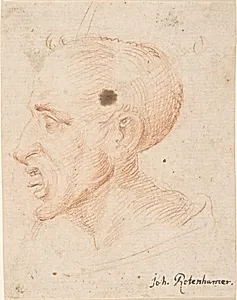
Bust of a Man Looking Left
Medium
Red chalk
Dimensions
sheet: 3 5/8 x 2 13/16 in. (9.2 x 7.1 cm)
Classification
Drawings
Department
Drawings and Prints
Museum
Metropolitan Museum of Art, New York, NY
Credit
Purchase, Jean A. Bonna Gift, 2007
Accession Number
2007.223.27
Rights
Public Domain
Tags
Art Historical Context
This delicate red chalk drawing, titled *Bust of a Man Left*, dates to the 17th and is attributed to Hanstenhammer the Younger or anonymous artist of the period. Measuring just 3⅝ × 2⅞ inches (9.2 × 7.1 cm), its intimate scale invites close contemplation, typical of preparatory sketches from the Baroque era. Housed in the Metropolitan Museum of Art's Department of Drawings and Prints—acquired through the Jean A. B Gift in 2007—it exemplifies the meticulous draftsmanship prized by European artists during a time when portrait studies captured the human form with lifelike precision. Rendered in sanguine red chalk, a favored medium for its warm tones and subtle blending, the work focuses on a male profile turned left, highlighting contours of the face, hair, and shoulders. This technique allowed artists like Rottenhammer, known for his Mannerist-influenced cabinet paintings, to explore anatomy and expression with fluid, economical lines. Such profile busts were common in 17th-century workshops, serving as studies for larger oil paintings or engravings, reflecting the era's fascination with classical antiquity and individualized likenesses. Though anonymous in attribution, the drawing's refined execution underscores the anonymous mastery of Northern European draftsmen, offering visitors a window into the creative process behind grander masterpieces. A testament to the artistry of the everyday sketch, it reminds us how small works fueled the visual splendor of the Dutch Golden Age and beyond.
About the Artist
Hans Rottenhammer the Younger|Anonymous, 17th century (German| ) · 1622 |1600 –1668 |1700
German, 1622–1668 Bamberg|