
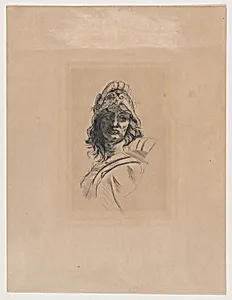
Bust of Bellona
1882–85
Medium
Drypoint
Dimensions
sheet: 10 9/16 x 8 1/16 in. (26.8 x 20.5 cm) image: 5 1/4 x 3 7/16 in. (13.4 x 8.8 cm) plate: 5 13/16 x 3 15/16 in. (14.8 x 10 cm)
Classification
Prints
Department
Drawings and Prints
Museum
Metropolitan Museum of Art, New York, NY
Credit
Gift of Donald Oenslager, 1964
Accession Number
64.560
Rights
Public Domain
Tags
Art Historical Context
In the late 19th century, French sculptor Auguste Rodin, renowned for his revolutionary bronzes like *The Thinker*, ventured into printmaking with works like *Bust ofona* (1882–85). This intimate drypoint captures the Roman goddess of war, Bell—fierce protector of warriors and embodiment of battle's fury—in a dramatic bust portrait. Rodin's choice of subject reflects his fascination with powerful, expressive female forms, echoing the emotional intensity of his sculptures. Drypoint, an intaglio technique where Rodin scratched directly into a metal plate, produces the velvety, burr-rich lines that give this print its sculptural depth. Measuring just 5¼ x 3⅜ inches in image size, it showcases his mastery in translating three-dimensional volume into two-dimensional intensity, with bold hatching evoking Bellona's armored visage and flowing hair. Created during Rodin's prolific Paris years, amid the Third Republic's cultural ferment, the print highlights his experimental spirit beyond marble and bronze. Housed in the Metropolitan Museum of Art's Drawings and Prints department (gift of Donald Oenslager, 1964), *Bust of Bellona* invites visitors to ponder war's mythic allure through Rodin's innovative gaze—a testament to how printmaking amplified his genius for human passion.
About the Artist
Auguste Rodin · 1840–1917
François Auguste René Rodin (1840-1917) stands as the founder of modern sculpture, transforming the art form from academic tradition into expressive modernism. Born into a working-class Parisian family, Rodin faced early rejection, failing three times to gain admission to the prestigious École des Beaux-Arts. This setback forced him to work as a craftsman for nearly two decades, though his 1875 tr...