
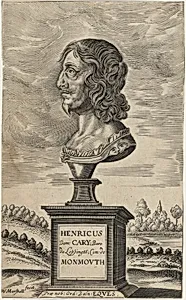
Bust of Earl of Monmouth
published 1649
Medium
engraving
Dimensions
sheet: 14.8 × 9 cm (5 13/16 × 3 9/16 in.)
Classification
Department
CG-E
Museum
National Gallery of Art, Washington, D.C.
Credit
Rosenwald Collection
Accession Number
1951.11.487
Rights
Public Domain
Art Historical Context
This delicate engraving by William Marshall, published in 1649, captures the bust of the Earl of Monmouth in a compact format measuring just under six inches tall. Created during the turbulent years of the English Civil War and the execution of King Charles I, such portrait prints served as affordable means of preservinges of nobility and political figures for a wider audience. Marshall, a leading English engraver of the Stuart period, specialized in finely detailed book illustrations and standalone portraits that blended classical bust traditions with contemporary realism. The work’s intimate scale and precise line work highlight the technical demands of engraving on copper plates, a medium prized for its ability to reproduce intricate details across multiple impressions. As part of the National Gallery of Art’s Rosenwald Collection, this print offers modern viewers a glimpse into 17th-century practices of commemoration and the role of graphic art in shaping public memory during a time of profound political change.
About the Artist
William Marshall · 1569–1677
**William Edgar Marshall (1837–1906)** was a preeminent American engraver and portrait painter, renowned for his meticulous line engravings on steel that captured the dignity and character of his subjects. Born in New York City to Scottish parents, Marshall began his career young, apprenticing at age seventeen in a watch-case factory before honing his skills engraving portraits at the U.S. Treasur...