
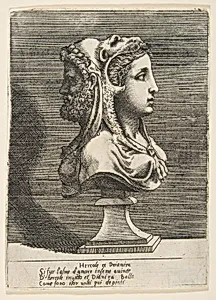
Bust of Hercules and Dejanira
ca. 1531–76
Medium
Engraving
Dimensions
sheet: 6 1/16 x 4 7/16 in. (15.4 x 11.2 cm)
Classification
Prints
Department
Drawings and Prints
Museum
Metropolitan Museum of Art, New York, NY
Credit
The Elisha Whittelsey Collection, The Elisha Whittelsey Fund, 1949
Accession Number
49.97.294
Rights
Public Domain
Tags
Art Historical Context
Behold the intricate *Bust of Hercules andjanira*, an engraving by the masterful Italian artist Giulio Bonasone, created sometime between 1531 and 1576. Bonasone, a prominent Bolognese printmaker of the Renaissance, was renowned for his reproductive engravings that captured the elegance of designs by masters like Raphael and Parmigianino. This-scale work (just 6 1/16 x 4 7/16 inches) depicts the mythological couple in a dramatic bust format—Hercules, the heroic strongman of classical lore, alongside his wife Dejanira, whose tragic story of love and unwitting betrayal would later lead to his demise. Engraving, Bonasone's chosen medium, exemplifies the technical virtuosity of 16th-century Italian printmaking. Using a burin to incise fine lines into a copper plate, he achieved exquisite detail, tonal depth, and expressive shading, making high art accessible through affordable prints. These works circulated widely across Europe, fueling the Renaissance fascination with antiquity and spreading humanist ideals. Housed in the Metropolitan Museum of Art's Drawings and Prints department, this piece from The Elisha Whittelsey Collection highlights Hercules' enduring cultural icon status—symbol of strength, valor, and human frailty. A captivating window into Mannerist interpretations of myth, it invites visitors to ponder the interplay of power and passion in ancient tales.
About the Artist
Giulio Bonasone · 1500–1600
Comment on works: History; Mythology