
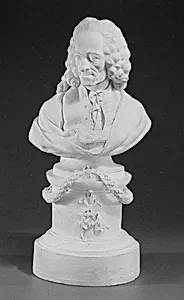
Bust of Voltaire
1769–77
Medium
Terre de Lorraine
Dimensions
Height: 9 3/4 in. (24.8 cm); Diam. of base: 3 7/8 in. (9.8 cm)
Classification
Ceramics-Pottery
Culture
French, Lunéville
Department
European Sculpture and Decorative Arts
Museum
Metropolitan Museum of Art, New York, NY
Credit
Gift of Joseph F. McCrindle, 1968
Accession Number
68.82
Rights
Public Domain
Tags
Art Historical Context
This exquisite *Bust of Voltaire*1769–77), by Paul-Louis Cyff at the renowned Lunéville faience in France, captures the intellect and iconic features of the Enlightenment philosopher François-Marie Arouet, better known as Voltaire. Produced the height of the French Rococo era transitioning toward Neoclassicism, the sculpture reflects the era's fascination with celebrity thinkers and the growing popularity of ceramic portraiture among the educated elite. At just 9¾ inches tall, its intimate scale made it ideal for private cabinets or scholarly studies, symbolizing admiration for Voltaire's bold critiques of religion, monarchy, and intolerance. Cyfflé, a master sculptor at Lunéville, employed *terre de Lorraine*, a distinctive unglazed stoneware with a matte, marble-like finish that mimics fine porcelain or bronze at a more accessible cost. This innovative medium, developed in Lorraine during the 18th century, allowed for remarkable detail in facial expression—from Voltaire's piercing gaze to his wry smile—while highlighting the factory's technical prowess in ceramics. Housed in the Metropolitan Museum of Art's European Sculpture and Decorative Arts department, this piece, gifted in 1968, exemplifies French cultural production from Lunéville, a hub of artistic innovation that blended utility with portraiture to immortalize the Age of Reason's luminaries.