
Bust Portrait of a Young Man
1620/25
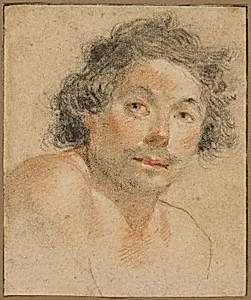
Medium
Black and red chalk, with stumping, on tan laid paper
Dimensions
14.2 × 11.9 cm (5 5/8 × 4 11/16 in.)
Classification
drawings (visual works)
Department
Prints and Drawings
Museum
Art Institute of Chicago
Accession Number
203870
Rights
Public Domain
About this artwork
The Parisian Simon Vouet became one of the most influential artists of his generation. He went to Italy as a young man and worked in Caravaggio’s wake in Rome. This compelling depiction of a disheveled, nude young man (possibly a self-portrait) has an immediacy and a naturalism characteristic of the Baroque. The figure’s engaging gaze into our space draws us in.
Art Historical Context
Step into the intimate world of 17th-century French Baroque drawing with Simon Vouet's *Bust Portrait of a Young Man*, created around 1620–25. This delicate study, housed in the Art Institute of Chicago's Prints and Drawings department, captures the subject's thoughtful gaze and soft features on a modest tan laid paper support, measuring just 14.2 × 11.9 cm. Vouet, a pivotal artist who bridged Italian influences with French classicism after years in Rome, showcases his mastery in this preparatory sketch, likely made for a painting or further development. Crafted in black and red chalk with stumping—a technique using a soft tool to blend tones for lifelike modeling—the drawing exemplifies Baroque naturalism. The warm reds evoke flesh tones, while blacks define contours and shadows, creating depth and volume in a compact format. Such mixed-media portraits were prized for their immediacy, allowing artists like Vouet to refine expressions and anatomy swiftly. This work highlights Vouet's role in importing Caravaggesque tenebrism and Italianate elegance to France, where he later became Louis XIII's court painter. For visitors, it's a window into the artist's process: a fleeting moment of youthful vitality preserved in chalk, revealing the humanity behind grand canvases.
About the Artist
Simon Vouet · 1590–1649
French painter. Comment on works: Portraits; Religious; Mythology; Allegory