
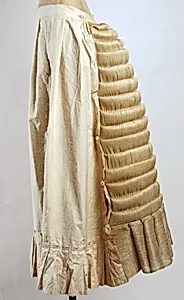
Bustle
Unknown Artist
1873
Medium
cotton, horsehair
Classification
Bustle
Culture
Austrian
Department
Costume Institute
Museum
Metropolitan Museum of Art, New York, NY
Credit
Purchase, Irene Lewisohn Bequest, 2002
Accession Number
2002.251
Rights
Public Domain
Art Historical Context
Step into the elegant world of 1870s fashion with *Bustle*, a example from Austria crafted in 1873. This undergarment exemplifies the era's dramatic shift toward exaggerated silhouettes, where the bustle emerged as a key feature after the decline of wide crinolines. Worn beneath skirts, it projected the hips backward, creating a striking, shelf-like posterior that symbolized refined femininity and social status in Victorian Europe. Made from cotton fabric stuffed and structured with horsehair, the bustle's medium was both practical and innovative. Horsehair provided lightweight rigidity and bounce, allowing for natural movement while maintaining shape—far more comfortable than rigid whalebone alternatives. This construction highlights the ingenuity of 19th-century dressmakers, blending everyday materials for high fashion. Housed in the Metropolitan Museum of Art's Costume Institute, acquired through the Irene Lewisohn Bequest in 2002, *Bustle* offers a tangible glimpse into Austrian cultural life. It underscores how clothing enforced gender norms and class distinctions, inviting us to appreciate the hidden architecture behind the glamour of Gilded Age gowns.